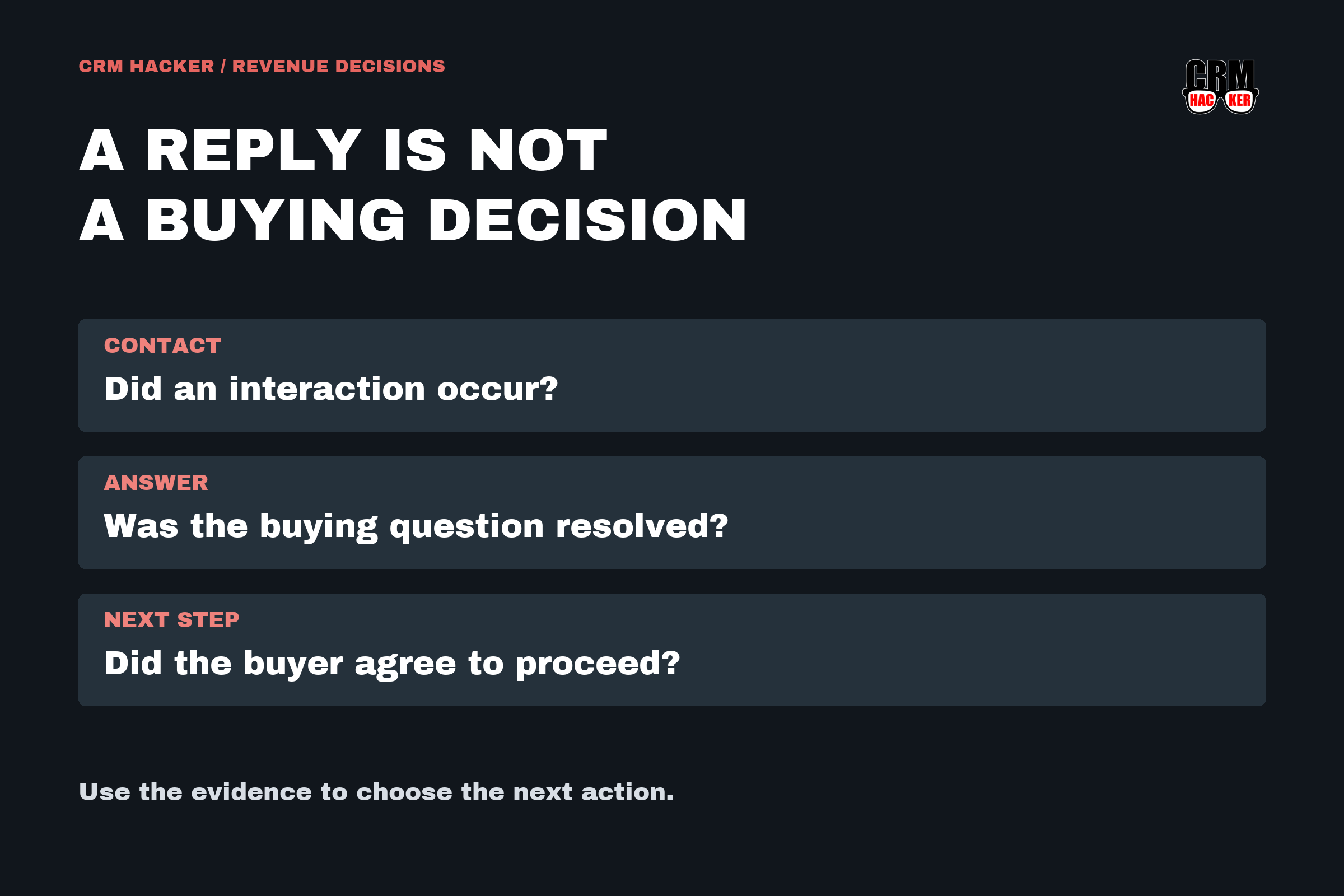
A reply can move a lead forward in the CRM without moving the buyer toward a purchase. If your handoff report treats every connection as sales-ready demand, sellers inherit conversations that still need a decision. More follow-up capacity may increase activity while leaving the same qualification gap.
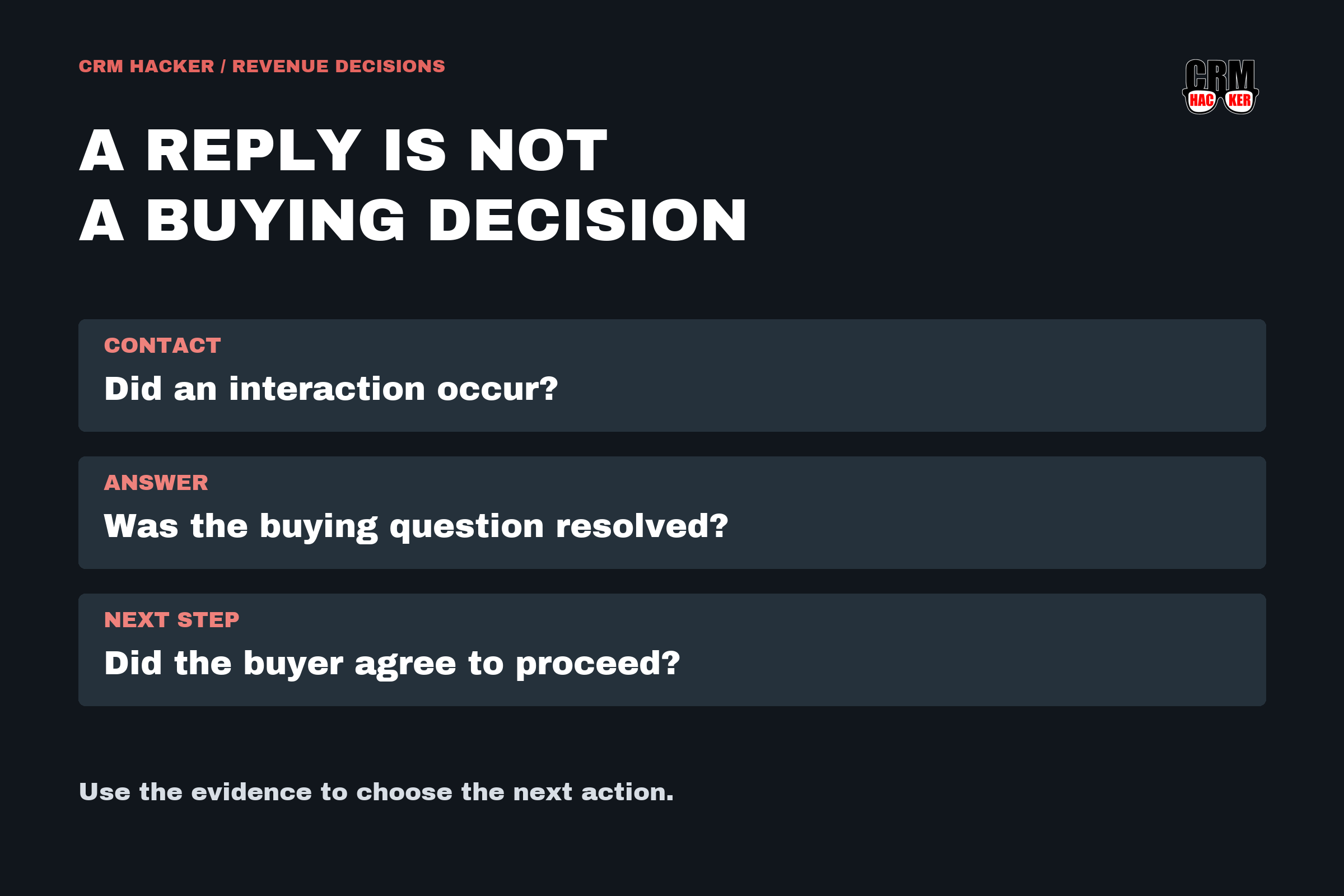
The leadership question is which evidence earns the next investment of selling time. Contact, a useful answer and an agreed buying next step are different outcomes. Keep them distinct before using stage movement to judge marketing quality or sales execution.
What a Connected stage actually establishes
HubSpot's lead pipeline automation documentation, updated August 10, 2026, says its default-pipeline progression can move a lead to Connected after an email reply, a meeting recorded as completed, or a call logged with a Connected outcome. The page applies to Sales Hub Professional and Enterprise. It also documents an exception: manually moving a lead backward prevents later automatic progression.
Those are product behaviors, not proof of a qualified buying need. Our interpretation is narrower: an interaction event is useful evidence that contact occurred, but the meaning of that interaction still matters. The documentation does not promise that every reply contains buying intent, budget or agreement to proceed.
Different replies deserve different next moves
Consider three hypothetical responses to a demo follow-up. One buyer asks whether a required integration is supported. Another says a colleague handles the decision. A third asks to reconnect after an internal planning review. All are interactions; none should automatically receive the same next action.
The integration question needs a reliable answer before another sales meeting is useful. The referral needs a handoff that preserves the original context and confirms the right participant. The later review needs an agreed follow-up point rather than a fresh outreach sequence that ignores what the buyer said.
A leadership dashboard that collapses these into Connected can show work moving while hiding why the next step is stalled. Keep the interaction milestone, then record the unresolved buying question and the next agreed action. Do not declare the lead unqualified merely because the buyer needs an answer; do not declare it qualified merely because the buyer replied.
Use the evidence to choose the next action.
Assignment, acceptance and response answer different questions
Assignment asks who the system selected. A record can be assigned to a queue without a person taking responsibility for it. Salesforce describes lead assignment to users or queues in its lead tracking guidance. A completed routing action is not, by itself, proof of a buyer response.
Acceptance asks who has taken the work. Define an explicit action or reliable event that shows a named owner accepted the request. An email notification being sent is weak evidence. So is a record merely appearing in a list. Acceptance can be a useful internal control without being the moment that starts the buyer's clock.
Response asks what the buyer received. A receipt confirmation and an answer from the right person serve different purposes. If an automated acknowledgment stops the only timer, a team can look fast while the buyer still waits for help. Track that acknowledgment separately when it matters.
The acceptance event and the response definition are recommended operating choices here, not standard Salesforce fields that every organization already has. Choose definitions people can apply consistently.
Preserve the request, not just the latest stage
For each request, preserve its original received time and a stable request identifier. Also track the current owner, latest assignment time, acceptance time, first useful response time, and final disposition. A disposition says what happened: accepted for sales follow-up, returned for a stated reason, or closed as ineligible.
The two clocks serve different decisions. Total elapsed time shows the buyer experience. Time with each owner shows where the process needs attention. Keep a history of transfers if you need to explain where the total came from; overwriting one owner and one timestamp cannot reconstruct it.
Do not use Lead Created Date as a universal substitute for request time. An existing person may submit a new request months later. Conversely, an integration may create the Salesforce lead after the request first arrived elsewhere. Decide which event represents the buyer's new request and carry that event across systems.
A repeat form submission also needs a policy. If it is a retry of the same request, it should not create a fresh clock or duplicate outreach. If it is a separate buying need, it may deserve a new work item. The difference is business meaning, not simply whether an email address matches.
This extends the ownership rules in our Salesforce lead routing guide: routing chooses the next owner; handoff measurement preserves what happened before that choice.
Make a return a decision, not an escape hatch
Sales should be able to return a request that is not ready or belongs elsewhere. But a generic rejected status can shift work without resolving it. Require a reason that determines the next action.
For a wrong-territory request, name the destination and keep it visible until someone accepts it. For missing information, identify the missing fact and the person responsible for getting it. For a buyer who asks to reconnect later, record the agreed date and next owner. Spam can leave the selling process, but it should remain explainable in the intake totals.
Keep customer waiting time separate from employee performance scoring. A rep should not inherit blame for a delay before they received a request. Nor should a transfer erase the delay from the company's view. Those are separate reporting questions and need separate measures.
Explicit ownership also prevents a loop where sales returns the record, marketing sends it back, and each handoff resets the local timer. Count repeat transfers on the same request. Review why the teams disagree before increasing automation.
Report the unresolved work, not only the completed replies
A response-time report built only from answered requests excludes the people still waiting. That can make the average look better precisely when the backlog gets worse.
Use two views. One follows requests received in a defined period and shows their outcomes, including still open. The other shows the current waiting work, its age, its owner and its next action. Do not label an unanswered request as a zero-minute response; it has no completed response time yet.
Review unanswered buying questions alongside completed interactions. A team can clear its contact-attempt queue while a technical or commercial question still prevents the buyer from choosing a next step. Keep these unresolved outcomes visible rather than treating the contact milestone as the finish line.
If the target uses business hours, define the calendar, holidays and time zone. Show elapsed real time separately when it helps explain the buyer experience. Pausing a clock because the customer asked for a later date may be reasonable; pausing it because an internal queue is busy hides a capacity problem.
Choose the intervention from the unresolved decision
If sellers repeatedly wait for technical answers, the next intervention may be reliable access to product expertise, not a higher activity target. If referrals lose context between teams, repair the transfer. If a buyer has explicitly deferred a decision, respect that timing rather than filling the gap with automated touches.
Review actual conversation evidence before drawing those conclusions. A stage alone does not establish the reason for delay, and a logged response does not establish conversion impact. The team should be able to explain what is still unknown, what would resolve it and why the next action deserves the buyer's time.
Where a manual stage correction changes automation behavior, operations should show how the request stays visible afterward. Do not assume a later activity will restore progression. This is a specific documented HubSpot limitation, not a claim about every CRM or pipeline.
Spend selling time on the decision that is still open
Use interaction data to establish what happened, then use buying evidence to decide what happens next. A contact milestone can be accurate while the commercial handoff remains incomplete. That distinction helps sales leaders choose between better answers, better transfers and additional capacity without pretending that stage movement proves demand.
If requests bounce between marketing and sales while the reports still look healthy, talk with CRM Hacker about the handoff. The initial conversation is free; assessment, implementation and ongoing support are scoped separately.