A temporary price sheet becomes the real price list when people keep using it after the decision behind it has expired. A seller copies last month's discount. An import loads the same numbers again. Billing looks up today's sheet to explain yesterday's deal.
The practical fix is to separate three things: the price available for a new quote, the terms saved on an issued quote, and the terms that authorize an invoice. Give each temporary exception an owner, an approval and an expiry. Preserve the commercial history when the exception stops being available.
Start with the decision the sheet is making
A spreadsheet can be a useful place to prepare a pricing proposal. The trouble starts when nobody can tell whether a row is a suggestion, an approved exception or a permanent change.
Pick one temporary price and trace its path. Who requested it? Who approved it? Which customers, products, quantities and currencies qualify? Where does the seller find it? What happens when it expires? Follow it into the quote and the billing handoff. That small investigation usually makes the ownership gaps visible.
The broader Revenue Cloud recap examines why commercial rules need to travel across the whole process. Here, the narrower question is how one temporary exception can stop applying to new work while remaining explainable in an existing deal.
Make the exception an approved record
Choose an accountable pricing owner who can resolve ambiguous cases. A systems administrator can implement the rule, but the commercial owner must decide what the rule means. Give sellers an identifiable backup contact when that owner is unavailable.
At minimum, the approved exception should capture:
Scope: customer or customer group, product, currency, unit of measure and any quantity or term conditions.
Value: the permitted price or discount, its baseline and whether other discounts can combine with it.
Authority: requester, approver, approval evidence and the reason for the exception.
Timing: effective date, expiry, the business timezone and the event that determines eligibility.
History: a stable identifier and version, with a record of replacements and extensions.
That last timing decision needs actual words. Does the exception apply when a line is created, when a quote is issued or when the customer accepts? A field named "End Date" cannot answer that on its own. Define the boundary, including what happens on the final day.
Keep proposed and approved changes distinct. Extending a price should require a recorded decision, not a quiet edit that makes an expired row look as though it was always valid.
Give the exception and the quote separate clocks
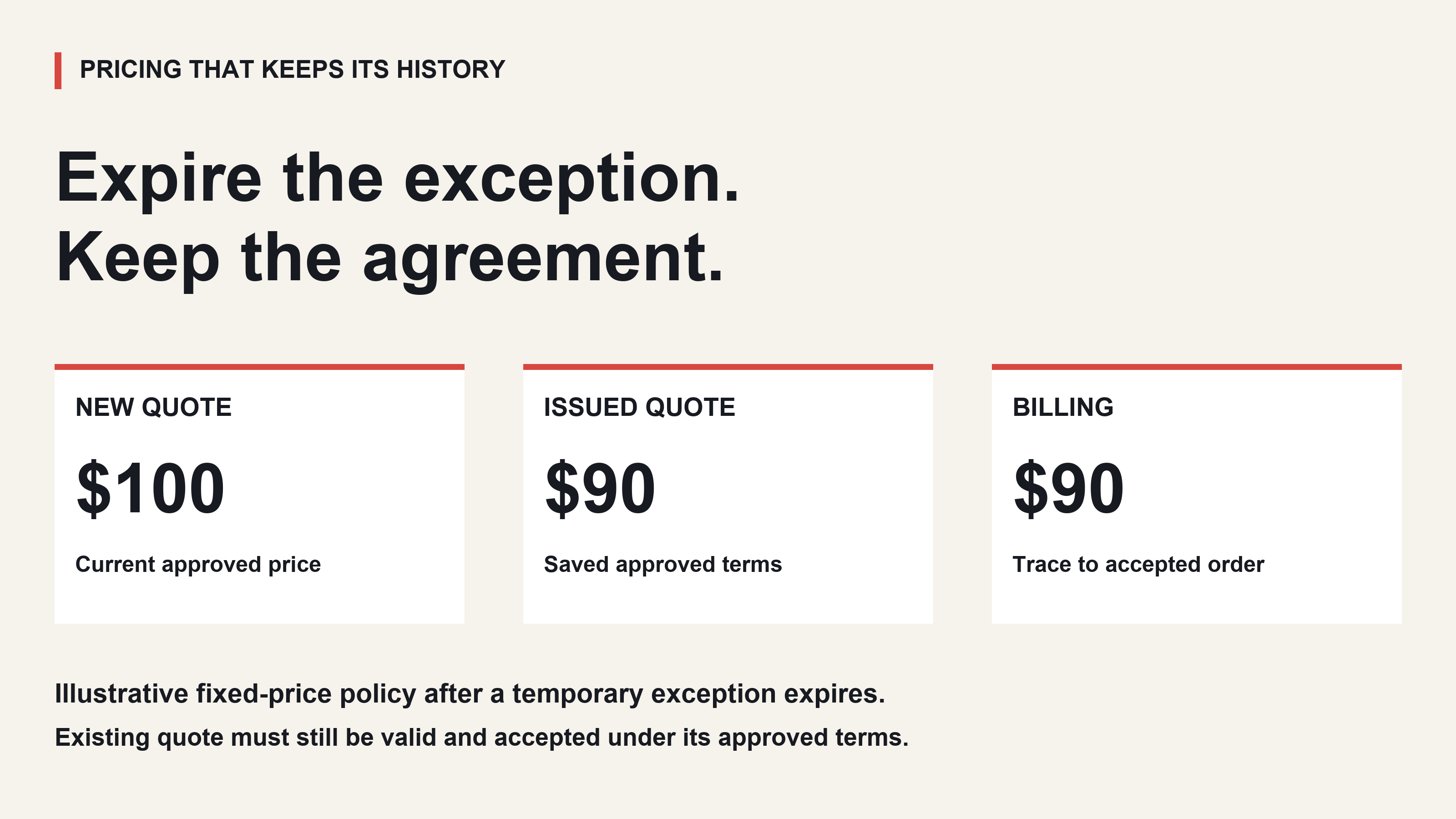
Consider this illustrative policy, not a client case or a recommended price. A product has a standard unit price of $100. An approved customer exception allows $90 on qualifying quotes issued through October 31. The policy separately allows an issued quote to remain valid through its stated acceptance deadline.
Quote Q-2048 is issued on October 30 at $90 per unit, with an acceptance deadline of November 15. When October ends, the exception closes for new quotes. Q-2048 still records what was offered under the approved policy.
Event and expected decision in this example
October 30: issue Q-2048: Save $90, the exception version, approval and November 15 acceptance deadline.
November 1: create a new quote: The expired exception is unavailable. Use the current approved price or obtain a new exception.
November 5: customer accepts Q-2048 unchanged: Use its approved $90 terms under this example's acceptance policy.
November 5: seller changes quantity or scope: Apply the amendment policy and required approval. Preserve the earlier version.
Later: prepare the invoice: Trace the charge to the accepted quote and order, including authorized changes.
Another business may require repricing before acceptance. That is a different policy and needs different controls. The important point is to decide explicitly, then make the quote, approval process and downstream systems agree.
Test the pricing behavior your system actually uses
Salesforce's managed-package CPQ training documents a specific behavior: contracted pricing is captured when the quote line is created, and later changes to the contracted-price record do not automatically change that captured price. It also recommends considering validation or approval for quote lines retaining older contracted prices. See Salesforce's contracted pricing guidance.
That line-creation behavior is different from the quote-issue policy in the example above. An implementation would need to reconcile the two. Do not assume that a date field alone enforces the business decision, or that another Salesforce quoting product behaves identically.
For each route that can create or change a quote, test before, on and after the expiry boundary. Include copied quotes, new lines on old quotes, bulk imports and integrations. Check whether recalculation changes a value that should remain fixed, or preserves a value that needs renewed approval. Also test overlapping exceptions and an unavailable approver.
Keep agreed values stable and corrections visible
An accepted commercial record should retain the values that explain the agreement. Store the applied amount, currency, quantity, discount basis and relevant term information with the approved quote version. Keep a reference to the pricing decision as well. A reference alone is insufficient if the referenced row can change without preserving history.
If an authorized change is needed, create a traceable revision or amendment. Record what changed, why, who approved it and which version downstream work must use. Restrict silent edits to agreed values; a correction should leave the earlier agreement understandable.
This separation also appears in other pricing systems. Stripe documents creating a new price when its amount changes, and explains that archiving a price stops new uses while existing subscriptions using it remain active. That is a useful lifecycle distinction, not a claim that Stripe and Salesforce share the same implementation. See Stripe's price management documentation.
Give billing an agreement it can trace
The billing handoff should identify the approved quote or order version and the lines being fulfilled. It should carry the pricing inputs needed for the agreed charging model. A fixed-price example may be simple; usage charges, taxes, proration and negotiated amendments need their own defined rules.
Do not reconstruct an agreed unit price from the current spreadsheet. If sales agreed $90 and the sheet now says $100, a fresh lookup can erase the explanation for the difference.
For a correction or credit, retain the connection to the original charge and the approved reason for the adjustment. Finance should define the treatment and approvals. The systems task is to preserve that decision and make mismatches visible, rather than silently forcing records to match.
Track exceptions such as a missing quote version, an expired override used on new work or an invoice price that differs without an approved reason. Assign a person to resolve each one. The Salesforce integration strategy guide covers ownership and reconciliation across systems in more depth.
Retire the workaround without losing the evidence
Start with one customer and product combination. Inventory where the temporary sheet is read, copied or imported. Move the approved decision into the chosen pricing workflow, test the boundary cases and compare the resulting quote and invoice inputs with the expected answer.
Then stop new operational use of the old sheet while retaining the history people need to explain earlier deals. Update templates, imports and instructions that still point to it. A replacement is incomplete if sellers can unknowingly keep using the old source.
Success is concrete: a seller can explain today's price, an approver can explain an exception, and billing can explain an older agreement after the exception expires.
Need help tracing that path through Salesforce and your billing systems? Talk with CRM Hacker about the pricing decision, its owner and the handoffs that need attention. The initial conversation is free; audits and implementation are scoped and paid.