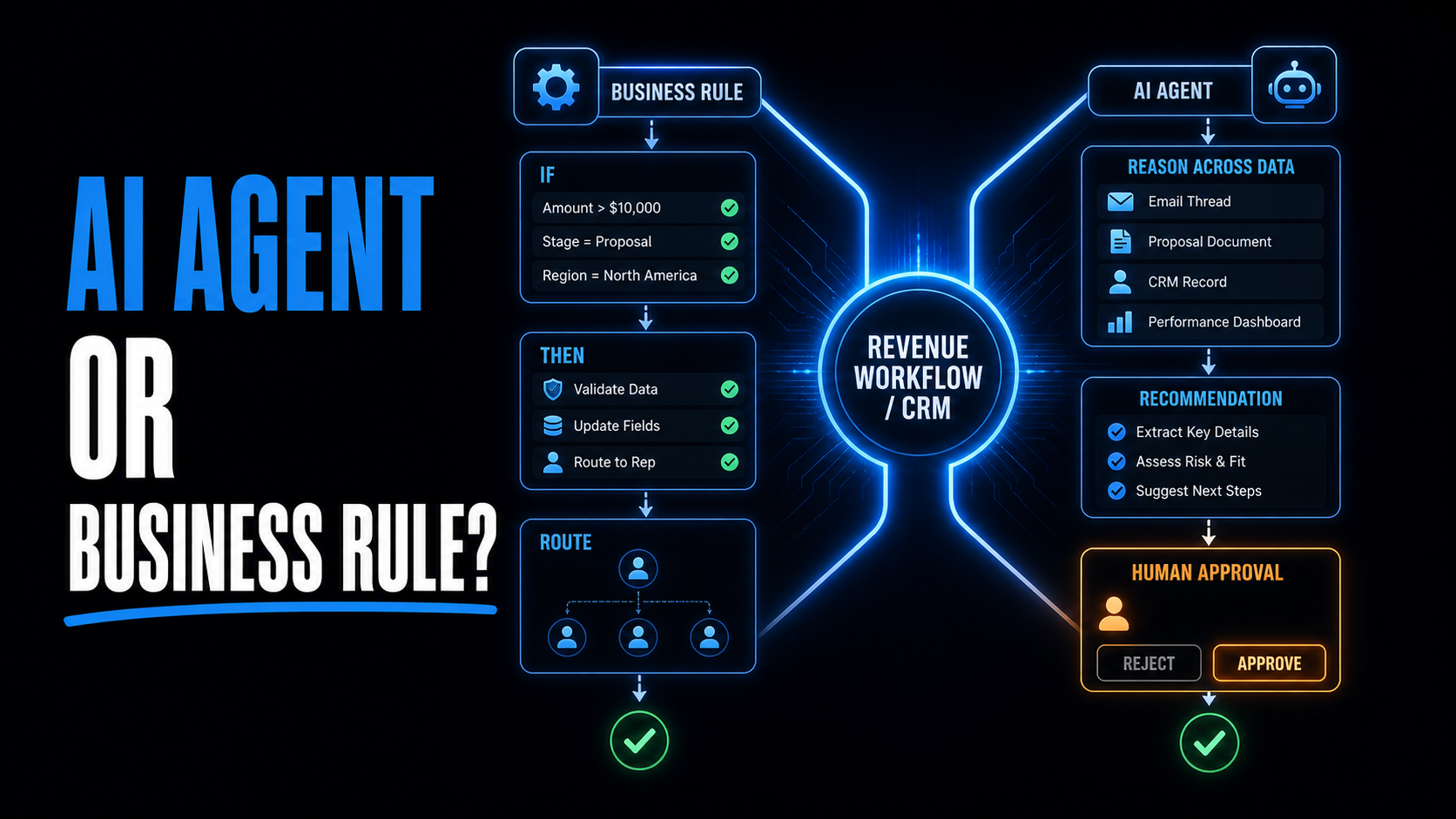
Use a business rule when the inputs and outcome can be defined in advance. Use an AI agent when the work requires interpreting messy context, handling variable paths, or producing a recommendation that cannot be reduced to a clean formula.
For most revenue operations teams, the right answer is not one or the other. It is a deterministic workflow at the core, an agent where judgment or unstructured information is required, and a human approval step before any high-risk action.
That distinction matters because the market is starting to push back on AI for the sake of AI. Recent enterprise coverage is asking whether agents are improving decisions or simply adding cost and complexity. McKinsey's 2026 State of AI survey reports that AI operating costs are already constraining use in some organizations. The question is no longer whether a company can deploy an agent. It is whether the workflow deserves one.
Why This Decision Is Suddenly Everywhere
On August 25, ITPro reported a growing warning from technology leaders: stop forcing AI into work that a straightforward rule can handle. The article's agent-versus-business-rule distinction is especially relevant to RevOps because revenue systems contain both kinds of work.
Lead assignment, stage validation, approval thresholds, consent rules, territory logic, and SLA timers are usually deterministic. Account research, email interpretation, call summarization, risk assessment, and exception triage often require context.
Treating both categories as agent problems creates an expensive system that is harder to test. Treating both as rule problems creates brittle automation that breaks whenever the input does not match the happy path.
This is another version of the operational weakness described in AI Is Becoming a CRM Stress Test. AI does not remove the need for clear data, ownership, and workflow architecture. It makes those foundations more important.
Use a Business Rule When the Decision Is Knowable in Advance
Rules are the better choice when the organization can define the condition, the allowed action, and the expected result before the workflow runs.
A rule is not less sophisticated because it does not use a model. In operational systems, predictability is a feature.
Use a deterministic rule when:
The required inputs are structured fields with controlled values.
The outcome can be expressed as clear if-then logic.
The same input should always produce the same result.
The action must be easy to audit and explain.
A wrong action would create financial, legal, security, or customer risk.
The workflow runs at enough volume that model consumption would add unnecessary cost.
The exception path can be routed to a person without stopping the core process.
Good RevOps examples include assigning leads by territory, blocking an opportunity from advancing when required information is missing, routing discounts above a threshold for approval, setting renewal reminders, enforcing campaign-member rules, and creating tasks when an SLA is breached.
If the logic can be written down completely and maintained by the team that owns the process, start with the rule.
Use an AI Agent When the Work Depends on Context
An agent makes sense when the workflow cannot know every input format or decision path in advance. The value comes from interpreting information, selecting tools, and adapting the next step, not from replacing a reliable rule with a probabilistic answer.
Use an agent when:
The input includes emails, notes, transcripts, documents, or other unstructured content.
The work requires synthesizing information across several systems.
The next step changes based on context that cannot be captured in a practical decision tree.
The useful output is a recommendation, summary, classification, or draft.
A human can review the result before it changes a material record or triggers an external action.
The organization can evaluate quality with real examples instead of relying on a polished demo.
The process has a safe fallback when the agent is uncertain or unavailable.
Good RevOps examples include summarizing account activity before a renewal review, classifying complex inbound requests, drafting an executive deal-risk brief, extracting terms from a proposal, identifying likely causes of pipeline movement, or recommending the next best action for a manager to review.
The agent should handle the ambiguity. It should not be given unlimited authority simply because it can understand the input.
The Best Architecture Is Usually Hybrid
The most dependable pattern combines deterministic controls with agent reasoning. The rules establish when the workflow runs, what data the agent may access, which actions are allowed, and when approval is required. The agent handles the part that actually needs interpretation.
A practical hybrid workflow looks like this:
A business event triggers the workflow, such as an opportunity entering negotiation or a renewal moving inside 120 days.
Rules confirm that required records, ownership, permissions, and data are present.
The agent reads approved context and produces a summary, classification, or recommendation.
Validation rules check the output for required fields, allowed values, thresholds, and obvious conflicts.
A person approves high-impact actions or handles low-confidence exceptions.
The system writes the approved result back to Salesforce and logs what happened.
This structure keeps business policy out of a prompt. It also prevents a team from hiding critical operating logic inside an agent that nobody can reliably inspect or maintain.
The broader design principle is part of CRM Hacker's Revenue Operating System Framework: automation should improve a defined revenue flow, not become another disconnected layer of technology.
Use This Six-Question Decision Test
Before approving an agent project, ask these questions in order:
Can we describe the decision with complete, stable if-then logic?
Are the required inputs structured, trusted, and available at the point of action?
Does the workflow require interpretation, synthesis, or a changing sequence of steps?
What is the cost of a wrong answer or unauthorized action?
Can we define a safe fallback, escalation path, and human approval boundary?
What measurable outcome will prove the agent is better than a rule, a simpler automation, or a manual step?
If the first two answers are yes and the third is no, use a rule. If the third is yes and the risk can be controlled, an agent may be justified. If nobody can answer questions four through six, the use case is not ready.
Measure the Completed Outcome, Not the Demo
An agent that produces an impressive response is not necessarily improving the operation. Measure the full workflow.
Useful measures include completion rate, exception rate, human rework, escalation rate, cycle time, cost per completed outcome, unauthorized-action attempts, user adoption, and the percentage of outputs accepted without correction.
Salesforce now emphasizes both Agentforce usage visibility through Digital Wallet and Agentforce Observability. Those capabilities matter because teams need to connect consumption, agent behavior, escalations, and business results. Usage by itself is not value.
Compare the agent against the simplest viable alternative. If a rule completes the work faster, more cheaply, and with fewer exceptions, the rule wins. If the agent reduces meaningful human effort while maintaining control and quality, scale it deliberately.
Where RevOps Should Start
Start with a workflow that contains real ambiguity but limited execution risk. Keep the first boundary narrow enough that the team can inspect every result.
Strong starting points include account and opportunity summaries, inbound-request classification, renewal preparation, data-quality exception triage, and recommended next steps that a manager approves.
Avoid starting with autonomous discount approval, contract commitments, record deletion, broad data access, customer-facing promises, or unrestricted write access across systems. Those use cases require mature governance and a much stronger control model.
If your team is trying to decide where agents belong, start with the workflow and operating requirements, not a product demo. Review CRM Hacker's AI consulting for Revenue Operations and Salesforce to evaluate readiness, choose a bounded use case, and design the right mix of rules, agents, and human control.
About CRM Hacker
CRM Hacker helps scaling companies build Salesforce, RevOps, and AI-ready revenue systems that reduce operational chaos and improve visibility. Explore our AI consulting services or Contact CRM Hacker to discuss an automation or agent workflow that needs a clearer operating model.