AI systems rely on consistency.
They expect:
Structured Salesforce data
Standardized lifecycle stages
Reliable lead routing
Governed automation
Predictable workflows
Accurate ownership logic
Clean account hierarchies
Consistent reporting models
When those foundations don't exist, AI struggles immediately.
And unlike humans, AI cannot naturally compensate for operational inconsistency.
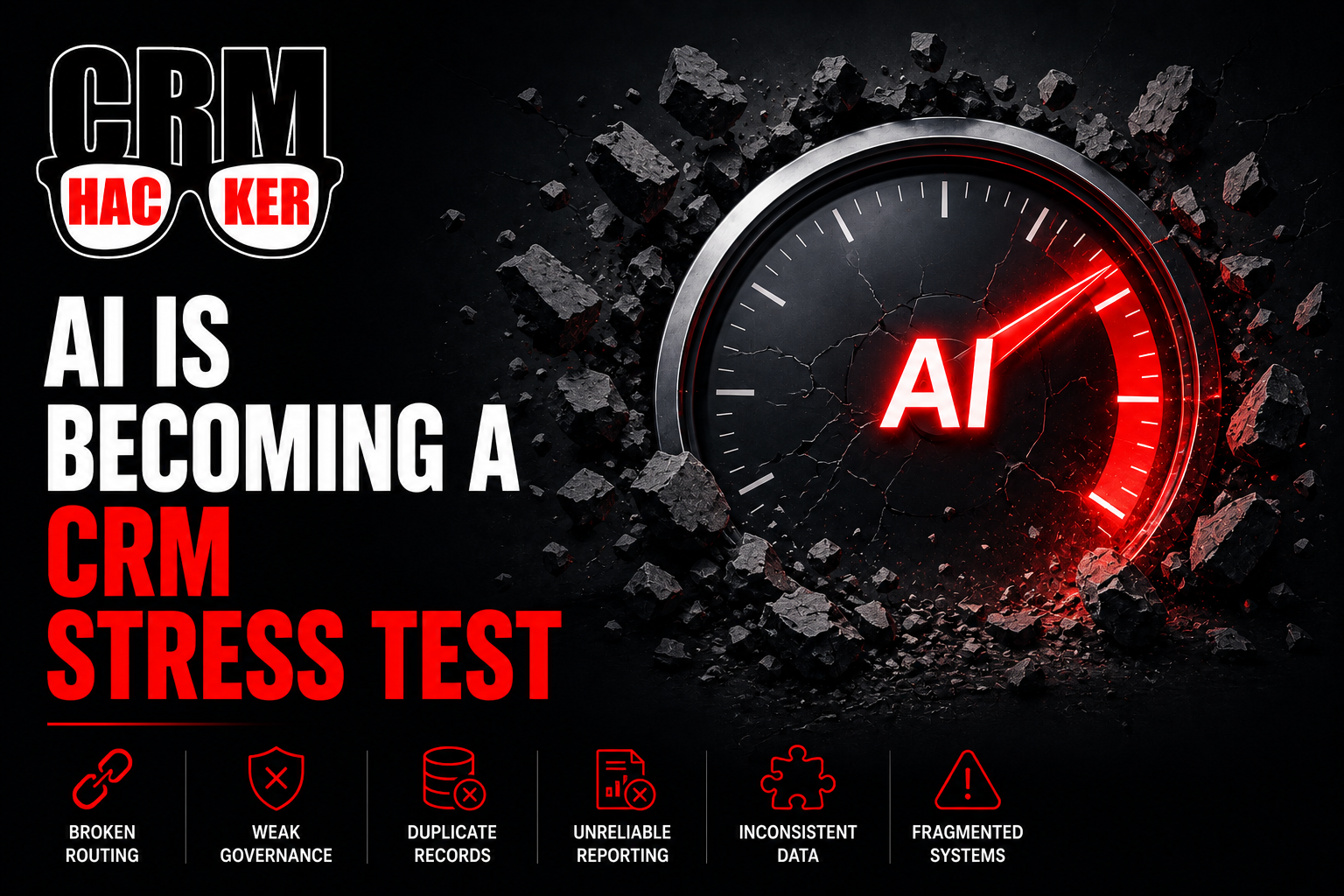
That's why AI is becoming one of the biggest stress tests for CRM maturity and RevOps infrastructure.
The cracks show instantly:
Duplicate records break recommendations
Weak governance creates workflow conflicts
Inconsistent attribution damages forecasting
Bad automation compounds errors
Reporting discrepancies create unreliable AI insights
Most of these problems existed long before AI adoption.
AI simply made them impossible to ignore.
Understanding AI Readiness
One of the biggest mistakes companies make is treating AI adoption like a software purchase instead of an operational transformation.
Because AI readiness is fundamentally a systems question.
Can leadership trust the CRM?
Can workflows scale reliably?
Can reporting support strategic decisions?
Can automation operate predictably?
Can GTM systems handle increased complexity?
If the answer is no, AI doesn't solve the problem.
It accelerates it.
That's why the companies getting the most value from AI are focusing heavily on:
Salesforce optimization
CRM governance
RevOps process design
Automation architecture
GTM systems engineering
Data quality
Integration management
Forecasting reliability
Operational maturity becomes the multiplier.
Building a Strong Foundation for AI
Many SaaS companies are still chasing AI tools before stabilizing their CRM foundation.
That approach rarely scales.
The strongest AI implementations happen when businesses first build:
Reliable Salesforce infrastructure
Scalable RevOps processes
Clean CRM architecture
Governed automation
Trusted reporting
Then AI becomes an acceleration layer instead of a cleanup project.
At CRM Hacker, we help companies identify operational bottlenecks that quietly break AI adoption before they become larger revenue problems.
Because eventually every AI conversation becomes a systems architecture conversation.
The businesses that solve the operational layer first will move faster than the companies still trying to automate chaos.
The Importance of Data Quality
Data quality is crucial for AI success.
Poor data leads to poor insights.
Clean data ensures that AI can deliver accurate recommendations.
Investing in data governance is non-negotiable.
It lays the groundwork for reliable AI outcomes.
Automation: The Backbone of Efficiency
Automation is not just about replacing manual tasks.
It's about creating a seamless workflow.
Effective automation reduces errors and enhances productivity.
When systems are automated correctly, teams can focus on strategic initiatives.
This is where true value lies.
Embracing Change: A Cultural Shift
Adopting AI is not just a technical challenge.
It's a cultural shift.
Teams must embrace new ways of working.
Training and support are essential.
Fostering a culture of innovation will drive success.
Conclusion: The Path Forward
AI is a powerful tool.
But it requires a solid foundation.
Companies must prioritize operational readiness.
By doing so, they can unlock the full potential of AI.
The future belongs to those who are ready.
Let's build a system that works.
Let's embrace the change.
Let's lead the way in operational excellence.
The journey starts now.