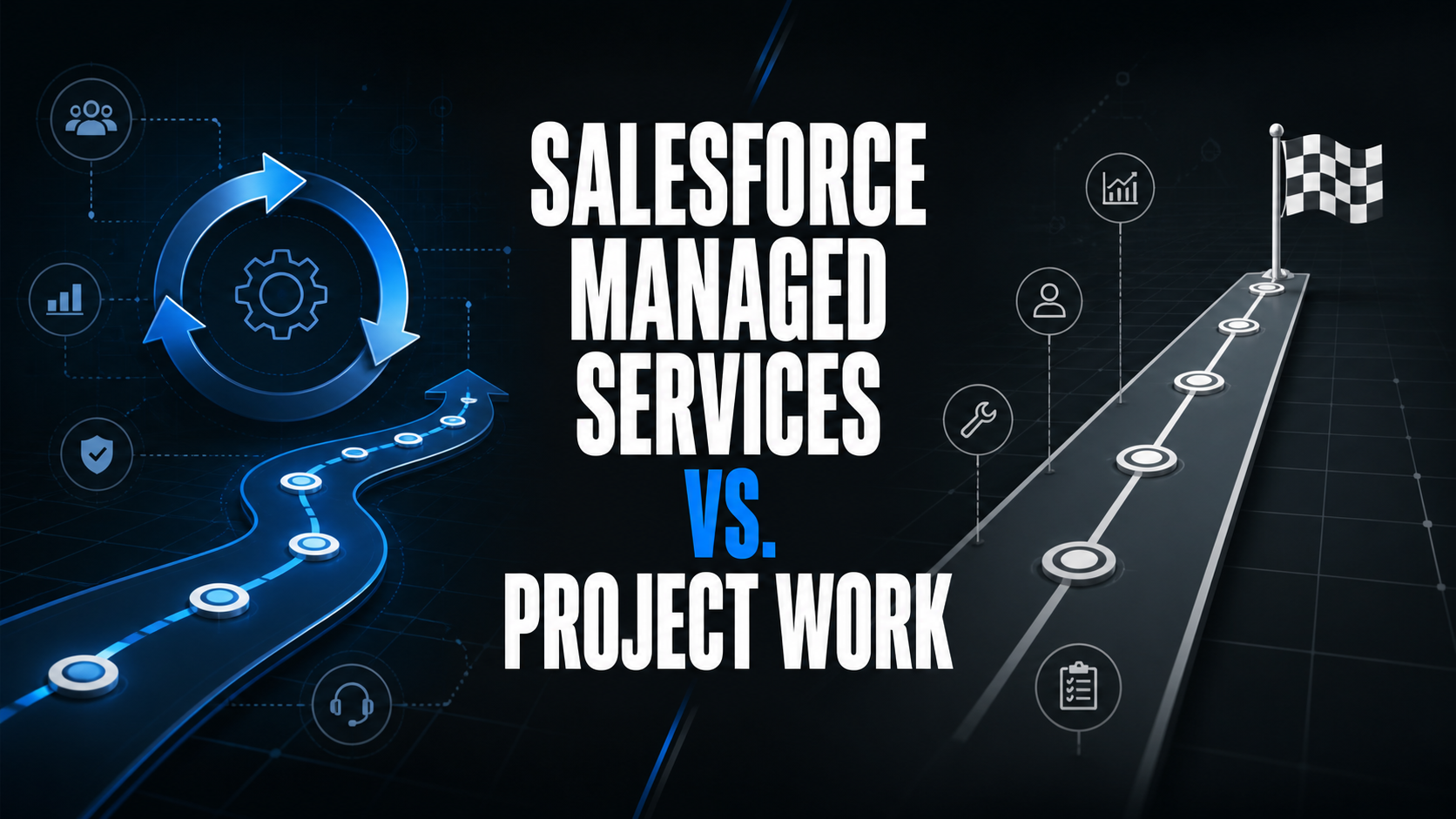
Choose project work when the outcome, scope, and finish line are clear. Choose Salesforce managed services when the work is continuous, priorities will change, and the business needs someone to own the health and evolution of the system after each release.
Neither model is automatically better. The real mistake is buying a delivery model that does not match the problem.
A project can force clarity and move a defined initiative across the finish line. Managed services can provide continuity, governance, and steady improvement. But a vague project becomes a change-order machine, while a weak managed-services agreement becomes an expensive ticket queue.
The decision should start with the shape of the work, not the way a vendor packages its hours.
The Short Answer: Projects Deliver a Defined Change; Managed Services Own an Ongoing System
Project-based Salesforce consulting is designed around a specific outcome. It has a beginning, a delivery plan, acceptance criteria, and an end. A new implementation, a major integration, a data migration, or a defined workflow redesign can fit that structure well.
Salesforce managed services are designed around continuous responsibility. The work may include support, administration, release management, backlog delivery, architecture guidance, data quality, reporting, documentation, and governance. The exact priorities change as the business changes.
The difference is not simply fixed fee versus monthly retainer. It is temporary delivery versus ongoing ownership.
That distinction matters because Salesforce rarely stays still. Sales processes change. Products and territories change. Leadership asks different questions. Integrations evolve. New automations interact with old ones. A system that supports revenue every day needs an operating model, not just occasional configuration.
When a Salesforce Project Is the Right Choice
A project works best when the team can define what will be different when the work is complete.
Good project candidates include:
A new Salesforce implementation with agreed business processes and a clear initial release
A migration with defined source systems, mappings, validation rules, and cutover criteria
A specific integration with known endpoints, ownership, error handling, and acceptance tests
A contained redesign of lead routing, opportunity management, quoting, or renewals
A technical-debt remediation effort with prioritized findings and a bounded scope
The strongest projects have stable decision-makers, documented assumptions, and measurable acceptance criteria. The team knows which outcomes matter, who can approve tradeoffs, and what is explicitly outside the current release.
Projects also make sense when capable internal ownership already exists. If an administrator, product owner, or RevOps team can govern Salesforce after the consultant leaves, the partner can deliver the defined change and complete a clean handoff.
The project model becomes risky when the request sounds precise but the underlying problem is not. "Fix reporting" may actually involve inconsistent stage definitions, incomplete data, conflicting ownership rules, and disconnected systems. Putting a fixed scope around an undefined operating problem does not create certainty. It hides assumptions until delivery.
If the current state is unclear, use the Salesforce org audit checklist before committing to a large build.
When Salesforce Managed Services Make More Sense
Managed services fit when Salesforce needs steady ownership and the backlog will never be permanently finished.
Common signals include:
Requests arrive every week, but nobody consistently prioritizes them
The business changes faster than the internal team can update Salesforce
Reports, automation, integrations, and user support compete for the same limited capacity
Knowledge is concentrated in one person, creating a continuity risk
The org needs architecture and governance, not only ticket completion
Releases happen, but documentation, testing, training, and adoption do not keep pace
This model is most useful when the partner is accountable for more than completing hours. A good managed-services relationship should establish an intake process, a prioritization cadence, named ownership, release standards, documentation expectations, and clear escalation paths.
It should also connect Salesforce work to business operations. Closing ten tickets is not meaningful if sellers still use spreadsheets, managers still rebuild forecasts, or integrations still fail without visibility.
Managed services should make the system easier to operate over time. If the arrangement only gives the team a monthly block of reactive support, it is staff augmentation with a subscription label.
Compare the Models Across Six Decision Factors
1. Problem clarity
Choose a project when the problem and desired outcome are understood well enough to define acceptance criteria.
Choose managed services when the environment needs continued diagnosis, iteration, and improvement. If nobody agrees on the current state, begin with an assessment before choosing either long-term structure.
2. Duration of the need
A one-time migration or clearly bounded build has a natural end. That favors a project.
Administration, data quality, release management, adoption, reporting, and roadmap governance are recurring responsibilities. That favors managed services or a strong internal owner.
3. Internal ownership
A project assumes somebody will own the result after handoff. That person must be able to manage priorities, support users, monitor automation, maintain documentation, and decide how future changes fit the architecture.
If that ownership does not exist internally, managed services can fill the gap. The agreement should still name an accountable business owner on the client side. A partner cannot make unresolved business decisions on behalf of leadership.
4. Skill breadth
A contained project can be staffed for the exact work: administrator, developer, architect, integration specialist, data lead, or change-management support.
Ongoing Salesforce ownership often crosses several disciplines. A managed team can provide broader coverage without requiring every skill to be hired full time. Confirm which roles are actually included and how quickly specialist capacity can be accessed.
5. Priority volatility
Projects need scope control. Frequent priority changes create rework, timeline movement, and commercial friction.
Managed services are better suited to a changing backlog, but flexibility still needs governance. The team should agree on who prioritizes work, how urgent requests displace planned work, and how larger initiatives are separated from routine capacity.
6. Accountability
Project accountability is tied to deliverables and acceptance criteria. Managed-services accountability should be tied to system health, operating cadence, responsiveness, roadmap progress, and the quality of releases.
In both models, avoid vague promises. Define who owns requirements, decisions, testing, deployment, documentation, training, and post-release monitoring.
The Hybrid Model Is Often the Most Practical
Many companies need both models at different times.
A managed-services team may own the ongoing backlog, governance, support, and smaller releases while a separate project handles a major implementation or integration. After the project, responsibility returns to the ongoing team with documentation, architecture decisions, test evidence, and a transition plan.
The reverse can also work. A project partner can deliver a major change, then provide a short stabilization period before the internal team takes ownership.
The key is to avoid blurred responsibility. If two teams touch the same automations, data model, or release pipeline, define decision rights and deployment ownership before work begins. Shared access without shared governance creates collisions.
The Revenue Operating System Framework provides a useful lens for deciding whether the need is a contained technical change or a broader operating-system problem across people, process, systems, data, automation, and AI readiness.
What to Ask Before Signing Either Agreement
Ask a project partner:
What assumptions must remain true for this scope and timeline to work?
How are acceptance criteria defined and approved?
Which dependencies and exclusions could create change requests?
Who owns testing, deployment, documentation, training, and handoff?
What happens during stabilization after launch?
Ask a managed-services partner:
What do you own beyond ticket completion?
How is work requested, prioritized, estimated, and approved?
Which roles are included, and when do we get architect or developer support?
How do you monitor releases, data quality, automation failures, and documentation?
How do larger projects get scoped without consuming the entire support backlog?
For either model, ask how success will be visible to the business. A list of completed tasks is not the same as a healthier Salesforce environment.
A Simple Decision Test
Use these three questions:
Can we clearly describe the outcome and finish line? If yes, start with a project.
Will this responsibility still exist six months after delivery? If yes, define ongoing ownership through an internal team or managed services.
Are we unsure what is actually broken? If yes, start with a diagnostic instead of forcing the uncertainty into a project or retainer.
You can use the CRM Health Grader for an initial signal across data, reporting, automation, adoption, and scalability. If the problem spans architecture, integrations, process, and governance, a structured assessment should come before a delivery commitment.
Choose the Model That Matches the Work
Use a project to deliver a defined change. Use managed services to operate and improve an evolving system. Use both when a large initiative needs focused delivery and the live environment still needs consistent ownership.
Do not choose based only on a lower hourly rate, a convenient retainer, or a promise of unlimited flexibility. Choose the model that makes responsibility clear and gives the business a reliable way to make decisions after the contract starts.
If your team is deciding between a scoped engagement and ongoing Salesforce ownership, review our Salesforce consulting services and contact CRM Hacker to map the work before selecting the commercial structure.
About CRM Hacker
CRM Hacker helps scaling companies build Salesforce, RevOps, and AI-ready revenue systems that reduce operational chaos and improve visibility. Explore our Salesforce consulting services for project delivery and ongoing platform support, or Contact CRM Hacker to discuss the model that fits your team.