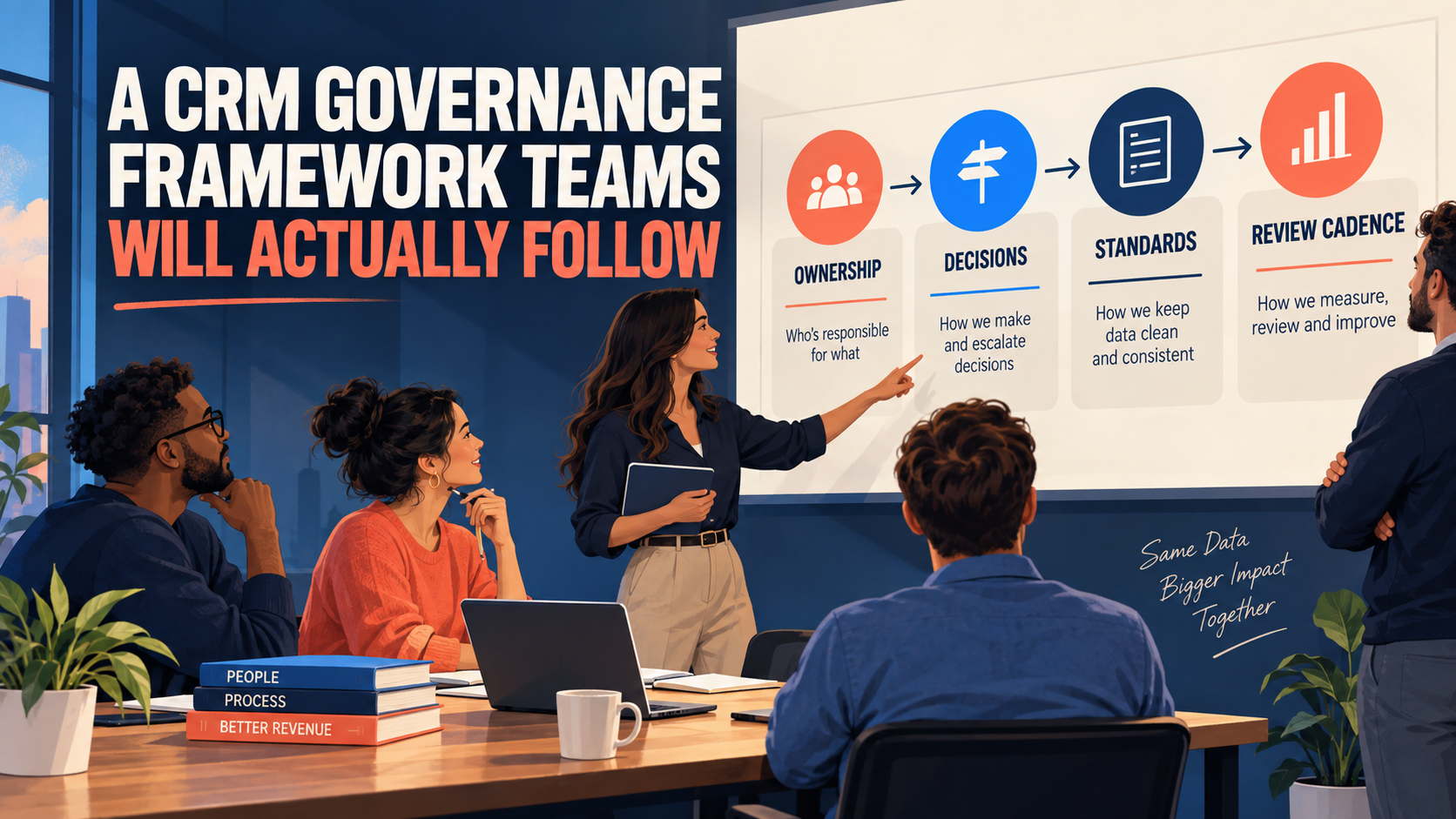
CRM governance is the operating system for deciding how customer and revenue systems change. A useful framework defines ownership, decision rights, standards, intake, prioritization, release controls, and a review cadence. It doesn't create a committee for every field.
Most governance programs fail because they're built as approval theater. The document gets longer, the meetings multiply, and teams still make changes through side conversations. Good governance should make safe changes easier and questionable changes harder.
Start With the Decisions, Not the Committee
Before naming a steering group, identify the decisions the business must make repeatedly:
Who can approve changes to lifecycle, lead, account, opportunity, and customer data?
Who owns the definition of each critical field and metric?
What requires architecture review?
How are urgent requests separated from important work?
Who decides whether an exception becomes a standard?
What evidence must exist before a change reaches production?
If those decisions remain vague, adding more people won't fix the problem. It'll only distribute the ambiguity.
Give Every Critical Area One Accountable Owner
Shared input is useful. Shared accountability usually isn't. Assign one accountable owner to each major domain: lead management, pipeline, forecasting, customer lifecycle, integrations, automation, reporting, and access.
That person doesn't have to do all the work. They're responsible for ensuring the definition is clear, the right people are involved, and a final decision gets made.
Name the accountable business owner.
Name the technical owner responsible for implementation quality.
Identify the people who must be consulted before material changes.
Use One Intake Process
If requests arrive through email, chat, meetings, direct messages, and hallway conversations, there is no real backlog. There are several competing versions of reality.
Create one visible intake process for every non-emergency change. A request should state the business problem, affected users, desired outcome, current workaround, deadline, dependencies, and the person who will confirm the result.
Don't require a fully designed solution. Requesters should explain the problem clearly; the system team should determine the safest design.
Prioritize With Explicit Criteria
A backlog ordered by job title isn't a strategy. Score work against revenue impact, customer impact, risk reduction, effort, dependency, urgency, and strategic alignment.
Urgency should require evidence. A date imposed by regulation, contract, launch, or a dependent program is different from a stakeholder wanting a change this week.
Define Guardrails for Data, Automation, and Reporting
For data, define naming standards, required ownership, acceptable picklist growth, duplicate handling, retention, and the source of truth.
For automation, require a named owner, documented trigger, failure path, test coverage, monitoring approach, and retirement plan. This matters when Salesforce technical debt has accumulated across years of urgent fixes.
For reporting, define important metrics once, document calculations and filters, and assign an owner. A dashboard isn't governed because it exists. It's governed when the business agrees on what its numbers mean.
Separate Standard Changes From Material Changes
Standard changes are low-risk, repeatable, and pre-approved within documented limits.
Material changes alter architecture, security, integrations, core objects, lifecycle definitions, or executive reporting.
Emergency changes address an active critical issue and require retrospective review.
This prevents governance from becoming a bottleneck while protecting decisions that can create expensive downstream consequences.
Build Release and Validation Into the Framework
Approval isn't the finish line. Every material change needs acceptance criteria, testing, a release owner, communication, and a defined check after launch.
Use the Salesforce org audit checklist when the current environment is too inconsistent to establish reliable standards.
Keep the Cadence Small and Useful
Weekly backlog triage for new requests and blockers
Biweekly or monthly prioritization with business owners
Architecture review only for changes that meet defined thresholds
Monthly review of incidents, adoption, data quality, and delivery performance
Quarterly review of standards, ownership, and major roadmap decisions
Cancel meetings that don't produce decisions. Record decisions where the team works. Governance should reduce coordination cost, not become another source of it.
Measure Whether Governance Is Working
Request-to-decision time
Work entering outside the intake process
Emergency-change volume
Reopened or reversed changes
Automation failures and data-quality exceptions
Adoption of released capabilities
Backlog age by priority
Use the measures to find unclear ownership, weak standards, overloaded teams, and recurring design problems, not to punish people.
The Revenue Operating System Framework provides the broader context: technology, process, people, data, governance, and measurement have to work together.
A Simple CRM Governance Charter
State the purpose and scope.
Name the accountable owners.
Define intake and prioritization.
Set thresholds for architecture, security, and executive review.
Document release and validation requirements.
Set the cadence and required outputs.
Choose the metrics used to improve the process.
If your team can't explain the framework in a few minutes, it probably needs simplification.
About CRM Hacker
CRM Hacker helps scaling companies build Salesforce, RevOps, and AI-ready revenue systems that reduce operational chaos and improve visibility. Explore our systems architecture approach or Contact CRM Hacker to build governance that fits the way your team actually works.