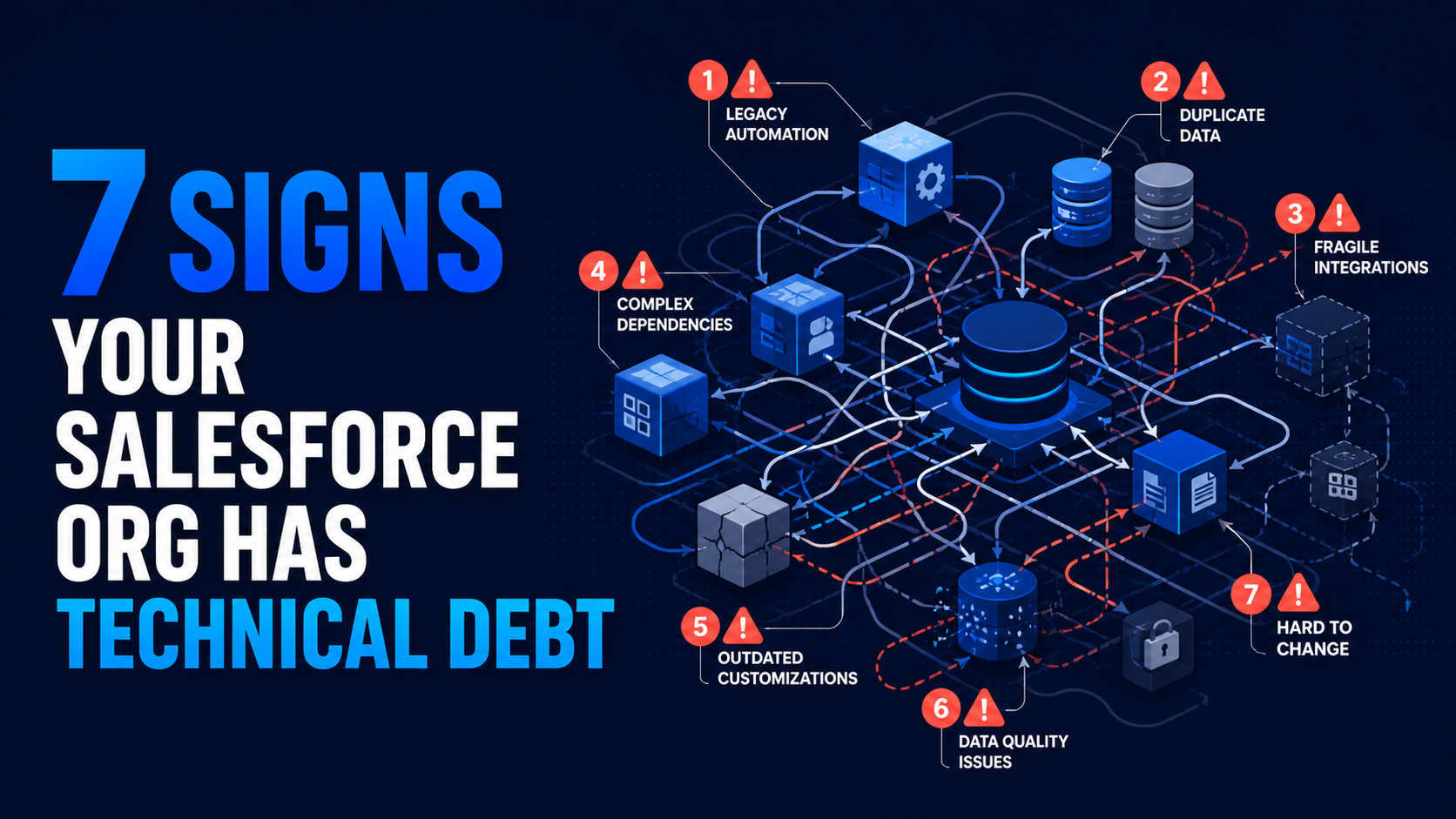
Salesforce technical debt is not simply old configuration. It is any design, customization, data structure, or operating decision that makes the next change slower, riskier, or more expensive than it should be.
The clearest warning is not the age of the org. It is the amount of effort required to understand, test, and safely change it. A ten-year-old field with a clear purpose and owner may be harmless. A flow created last month with duplicate logic, no fault handling, and no documentation is already debt.
Salesforce's Well-Architected guidance treats technical debt as a normal condition that must be identified, planned for, and remediated. The problem is not that debt exists. The problem is when nobody can see it, measure its business impact, or make room to reduce it.
1. Every Salesforce Change Takes Longer Than It Should
A small request arrives: add a qualification field, adjust lead routing, update an opportunity stage, or change an approval threshold. Instead of estimating the work, the team first has to investigate what might break.
That investigation is healthy when the change is genuinely complex. It is a warning sign when every request triggers the same uncertainty.
Multiple automations update the same fields
Dependencies are discovered only during testing
Nobody knows which configuration is still active
Sandboxes do not represent production
Regression testing depends on individual memory
Releases require emergency fixes or repeated rollbacks
Technical debt creates a tax on change. The business feels that tax as slower delivery, inconsistent estimates, and reluctance to improve important workflows.
2. Nobody Can Explain Why Important Configuration Exists
Fields, record types, validation rules, profiles, permission sets, flows, Apex, reports, and integrations should have a current business purpose. That does not mean every component needs a novel-length document. It means someone can explain what it supports, who owns it, and what would happen if it changed.
Mystery configuration is dangerous because the team cannot distinguish critical controls from abandoned experiments.
Fields have vague names, no descriptions, and unclear usage
Automations are owned by inactive users
Reports reference logic nobody recognizes
Hard-coded IDs, dates, email addresses, or thresholds remain in production
Installed packages are still active even though the original use case is gone
Teams preserve components solely because nobody is confident enough to remove them
If the only documentation is tribal knowledge, the org is borrowing reliability from whoever happens to remember the past.
3. Automation Overlaps, Conflicts, or Fails Silently
Salesforce automation debt usually appears as a collection of locally reasonable decisions. One flow handles routing. Another updates ownership. Apex from an older project touches the same record. A managed package applies additional logic. An integration writes the value back later.
Each component may work in isolation. Together, they create unpredictable behavior.
Watch for recurring record-lock errors, unexpected field changes, duplicate notifications, excessive updates, circular logic, failed scheduled jobs, and users retrying actions because the first attempt appeared to do nothing.
The goal is not to force every automation into one giant flow. It is to establish clear responsibility, predictable execution, reusable logic, fault handling, monitoring, and a safe way to test changes.
4. Different Reports Produce Different Versions of the Truth
Reporting disagreements are often treated as dashboard problems. They are usually symptoms of deeper debt.
If sales, marketing, finance, and leadership calculate pipeline, conversion, bookings, or renewals differently, inspect the definitions and data model before rebuilding charts. The org may contain duplicate fields, inconsistent stage usage, incomplete historical data, conflicting date logic, or transformations that occur outside Salesforce.
Teams export data to spreadsheets before trusting it
Executives ask which dashboard is the correct one
Pipeline numbers change depending on who runs the report
Critical metrics rely on manual adjustments
Historical reporting breaks when fields or stages change
Users enter data differently because definitions are not shared
A dashboard cannot create a single source of truth when the underlying operating definitions are still negotiable.
5. Integrations Are Fragile and Ownership Is Unclear
A healthy integration has a known system of record, documented data direction, authentication ownership, error handling, monitoring, and a recovery path. A debt-heavy integration works until it does not and then the team searches for the one person who knows how to restart it.
Warning signs include unexplained data overwrites, duplicate records, expired credentials, manual file transfers, unmonitored middleware queues, integration users with excessive permissions, and failures discovered only after a business report looks wrong.
Integration technical debt is especially expensive because the failure crosses system and team boundaries. Salesforce may show the symptom even when the root cause sits in marketing automation, billing, ERP, enrichment, support, or custom middleware.
6. Users Build Workarounds Because Salesforce Slows Them Down
Low adoption is not always resistance to change. Sometimes it is rational behavior.
If users track deals in spreadsheets, send handoff details in Slack, maintain private notes, duplicate customer information across tools, or ask operations to update records for them, inspect the workflow before scheduling more training.
Common causes include required fields that appear too early, page layouts that ignore the user's role, duplicate entry, confusing terminology, excessive clicks, missing context, automation that behaves inconsistently, or reports that do not help users make decisions.
Training can explain a usable process. It cannot make a badly designed process worth following.
7. Technical Debt Has No Place in the Roadmap
The final sign is organizational: everyone knows the org is getting harder to maintain, but every planning cycle prioritizes new requests and leaves remediation for later.
Technical debt does not need a blank check. It needs the same discipline as feature work: evidence, business impact, scope, owner, acceptance criteria, and timing.
Security or access exposure
Revenue processes that fail or require manual rescue
Unreliable executive reporting
Automation and integration failures
Architecture that blocks high-value changes
Legacy components creating release or platform risk
Repeated support work caused by the same underlying design
Salesforce recommends connecting remediation to the cost or benefit of action versus inaction. That framing matters. Leadership is more likely to prioritize "restore reliable lead assignment and eliminate manual rerouting" than "clean up old flows."
How to Prioritize Salesforce Technical Debt
Do not rank debt by age, component count, or how irritating it is to the admin. Rank it by business risk and the amount of future friction it creates.
Stabilize immediate risk. Address security exposure, failing integrations, broken revenue workflows, data loss, and reporting used for critical decisions.
Map dependencies. Identify which processes, objects, automations, integrations, and teams will be affected before changing or deleting anything.
Connect each item to business impact. Describe the operational cost, delivery delay, failure risk, or blocked capability in plain language.
Group related debt into coherent work. Fixing one field or flow at a time can preserve the architecture that created the problem.
Define proof of improvement. Measure reliability, release effort, error volume, manual work, data completeness, or another result that demonstrates the debt was actually reduced.
Create a recurring cadence. Review technical debt monthly or quarterly instead of waiting for the next crisis or transformation project.
The Salesforce org audit checklist provides the broader inspection framework for process, data, security, automation, integrations, reporting, adoption, and governance. Use it to build evidence before turning the technical-debt list into a roadmap.
When Technical Debt Becomes a Business Problem
Technical debt deserves attention when it changes what the company can safely do.
If leadership cannot trust the forecast, sales operations cannot change routing without breaking downstream logic, integrations fail without alerts, or every release requires a forensic investigation, the org is no longer merely untidy. It is constraining the operating model.
For a quick signal across data quality, reporting, automation, adoption, security, and scalability, start with the CRM Health Grader. When the problems span architecture, process design, integrations, and ownership, a structured assessment is more useful than another batch of isolated tickets.
The decision may also require the right ownership model. This guide to choosing between a Salesforce administrator and a consulting partner explains when ongoing administration is sufficient and when broader recovery or architecture expertise is needed.
About CRM Hacker
CRM Hacker helps scaling companies build Salesforce, RevOps, and AI-ready revenue systems that reduce operational chaos and improve visibility. Review our Salesforce and RevOps consulting services if technical debt is making your org harder to change, or Contact CRM Hacker to discuss a focused assessment and remediation roadmap.