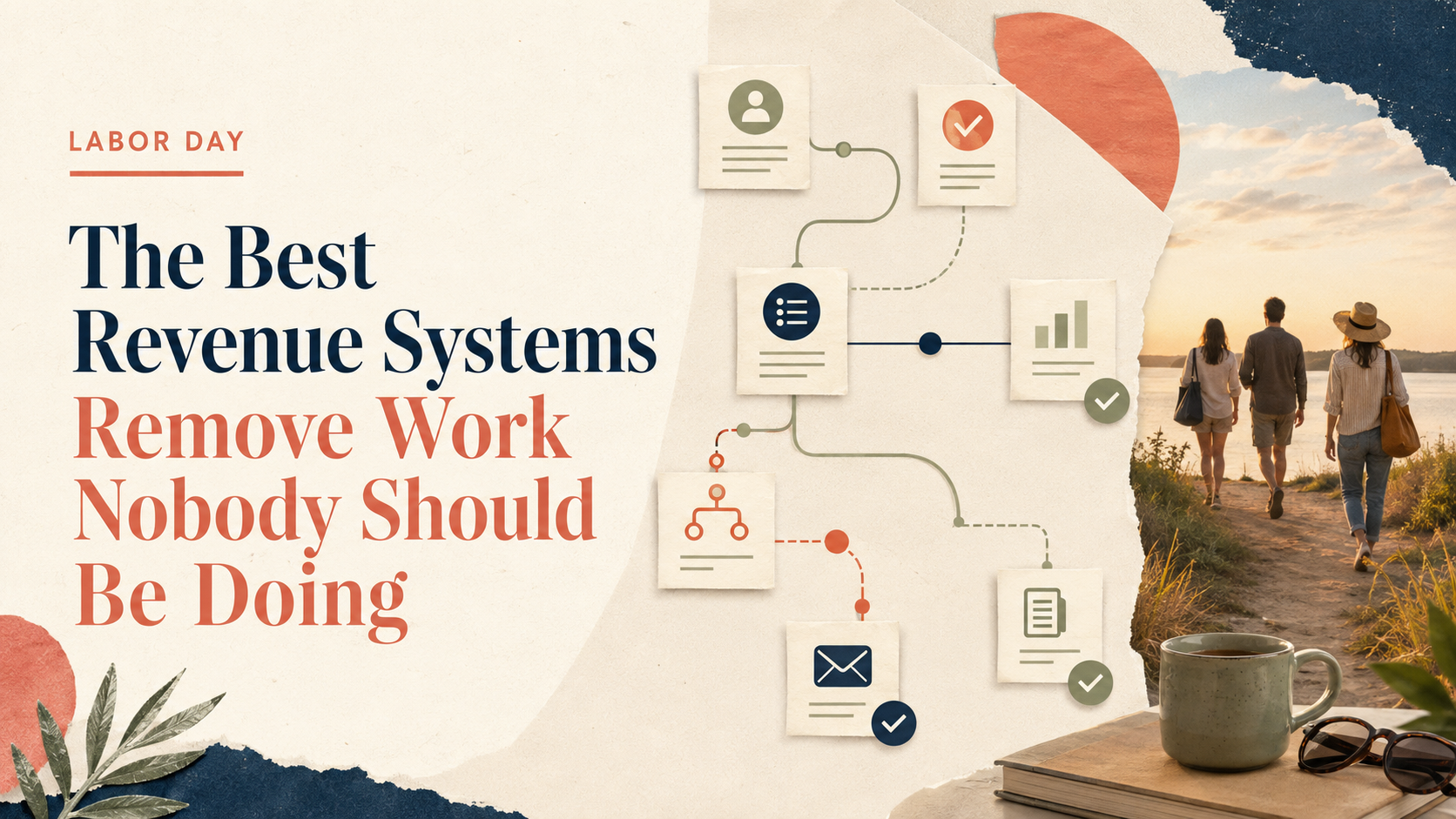
Labor Day is supposed to be a break from work. It's also a useful reminder to look at how much unnecessary work our systems create in the first place.
Nobody should spend Monday morning copying the same customer information into three tools. A manager should not have to rebuild the same report every week. A salesperson should not need a private spreadsheet to understand what Salesforce is supposed to tell them.
That is not productivity. It is operational friction dressed up as a job requirement.
The best revenue systems do more than store information. They remove repeatable work, make ownership obvious, and give people enough context to make a decision without hunting through tabs, messages, and spreadsheets.
The work your revenue system should remove
Start with the work that is predictable, repeatable, and adds no judgment of its own.
Entering the same account or contact data in multiple systems
Manually assigning leads that could follow clear routing rules
Chasing owners for routine status updates
Rebuilding reports that answer the same weekly questions
Fixing preventable sync errors one record at a time
Sending reminders for steps the system already knows are overdue
Some manual work is necessary. A good discovery conversation, a thoughtful forecast call, or a difficult customer decision cannot be reduced to a checkbox. But moving data, notifying an owner, applying a defined rule, and surfacing an exception should not require human effort every time.
When people spend their attention on system chores, the business pays twice. The task takes time, and the constant switching leaves less capacity for the work that actually needs experience and judgment.
Automation is not the same as simplification
It is easy to automate a bad process and make the problem move faster.
Before building another flow, integration, or AI agent, ask whether the step should exist at all. Then decide whether it needs a person, a deterministic rule, an automated notification, or an exception queue.
A useful sequence is simple:
Remove steps that do not support a decision, customer outcome, compliance need, or reliable handoff.
Standardize the steps that remain so people are not inventing the process every time.
Automate the predictable work.
Route exceptions to a named owner with the context needed to act.
Measure whether the change actually reduced effort and improved the outcome.
If an automation only creates more alerts, fields, or places to check, it did not give the team capacity back. It just changed the shape of the busywork.
Our Revenue Operating System Framework is built around this broader view. Technology is only one part of the system. Process, ownership, data, measurement, and governance determine whether the automation helps or creates another layer to maintain.
A practical Labor Day audit
You do not need a six-month transformation plan to find the first opportunities. Ask the people doing the work five direct questions:
What information do you enter more than once?
What do you regularly track outside the CRM because the system is not trusted?
Which reports or updates do you rebuild manually?
What work sits idle because ownership is unclear?
Which recurring task would nobody miss if the system handled it correctly?
Look for answers that appear across roles. If sales, marketing, service, and finance all describe the same handoff problem from different angles, that is probably not a training issue. It is a system-design issue.
Then separate symptoms from causes. A spreadsheet may be the visible workaround, but the underlying cause could be incomplete data, an unusable process, unclear definitions, missing integration logic, or reporting that does not answer the business question.
The Salesforce org audit checklist can help you inspect those layers before jumping into configuration. If you need a quicker starting signal, the CRM Health Grader highlights risk across data, reporting, automation, adoption, and scalability.
Give the team capacity back
The goal is not to remove people from the work. It is to remove work that prevents people from doing their best work.
A healthy revenue system should make the next action easier to see, reduce duplicate effort, preserve context across handoffs, and surface the exceptions that genuinely need attention. It should also be understandable enough that the team can operate it without relying on one person who knows every workaround.
This Labor Day, pick one recurring task that frustrates the team and trace it from start to finish. Count the handoffs, duplicate entries, status checks, and places where somebody has to remember what the system should already know.
Then fix the smallest root cause that gives meaningful time back. That is a better automation strategy than adding technology because it is available.
If your Salesforce environment is creating more work than it removes, explore our Salesforce consulting services or contact CRM Hacker to identify the friction before adding another layer.
About CRM Hacker
CRM Hacker helps scaling companies build Salesforce, RevOps, and AI-ready revenue systems that reduce operational chaos and improve visibility. Explore our Salesforce consulting services for architecture, automation, and operational improvement, or Contact CRM Hacker to discuss what your team should stop doing manually.