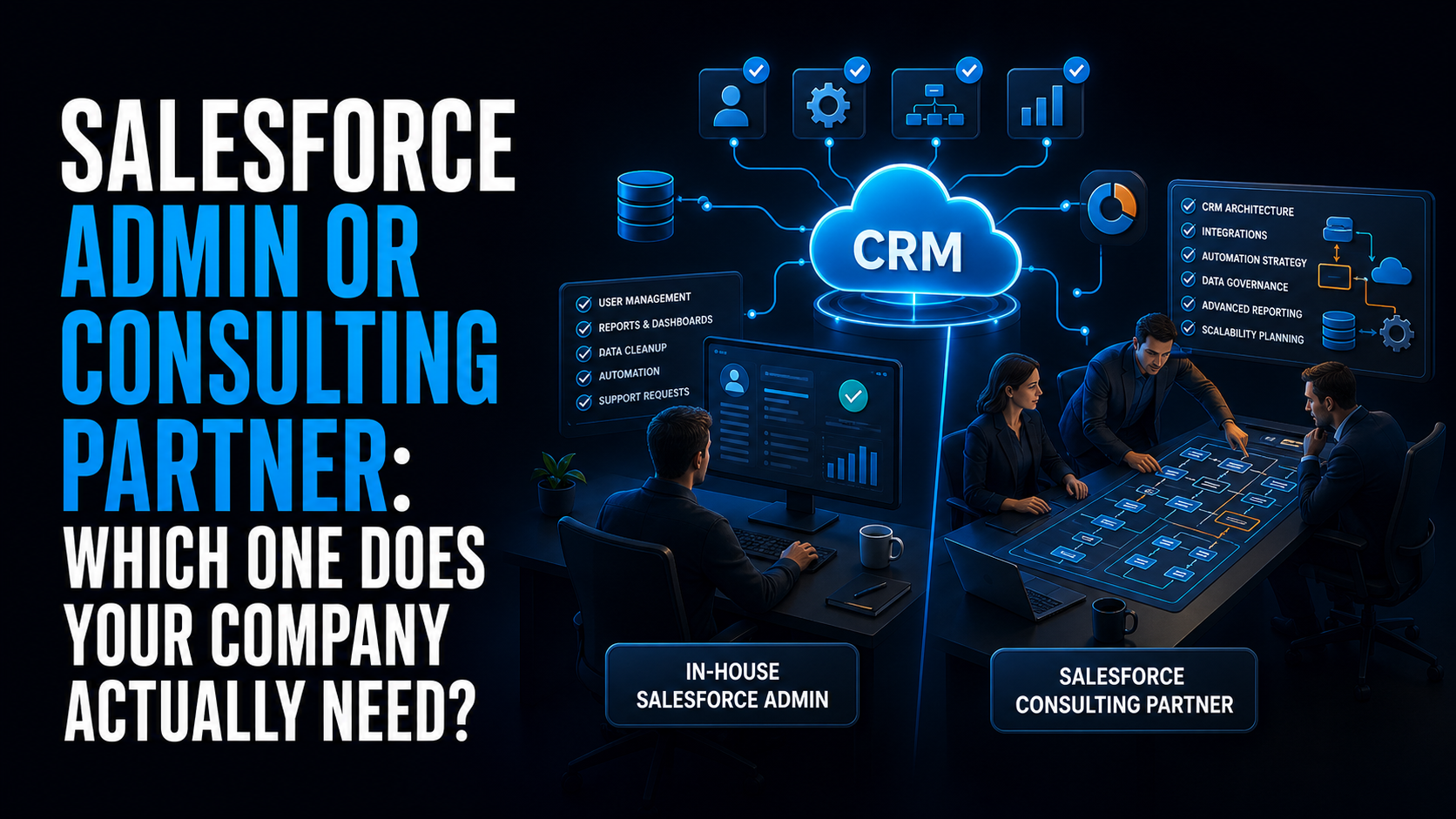
The short answer is simple: hire a Salesforce admin when the system is fundamentally sound and needs consistent day-to-day ownership. Bring in a consulting partner when the company needs to redesign processes, repair architecture, handle a complex implementation, or coordinate work across multiple systems and teams.
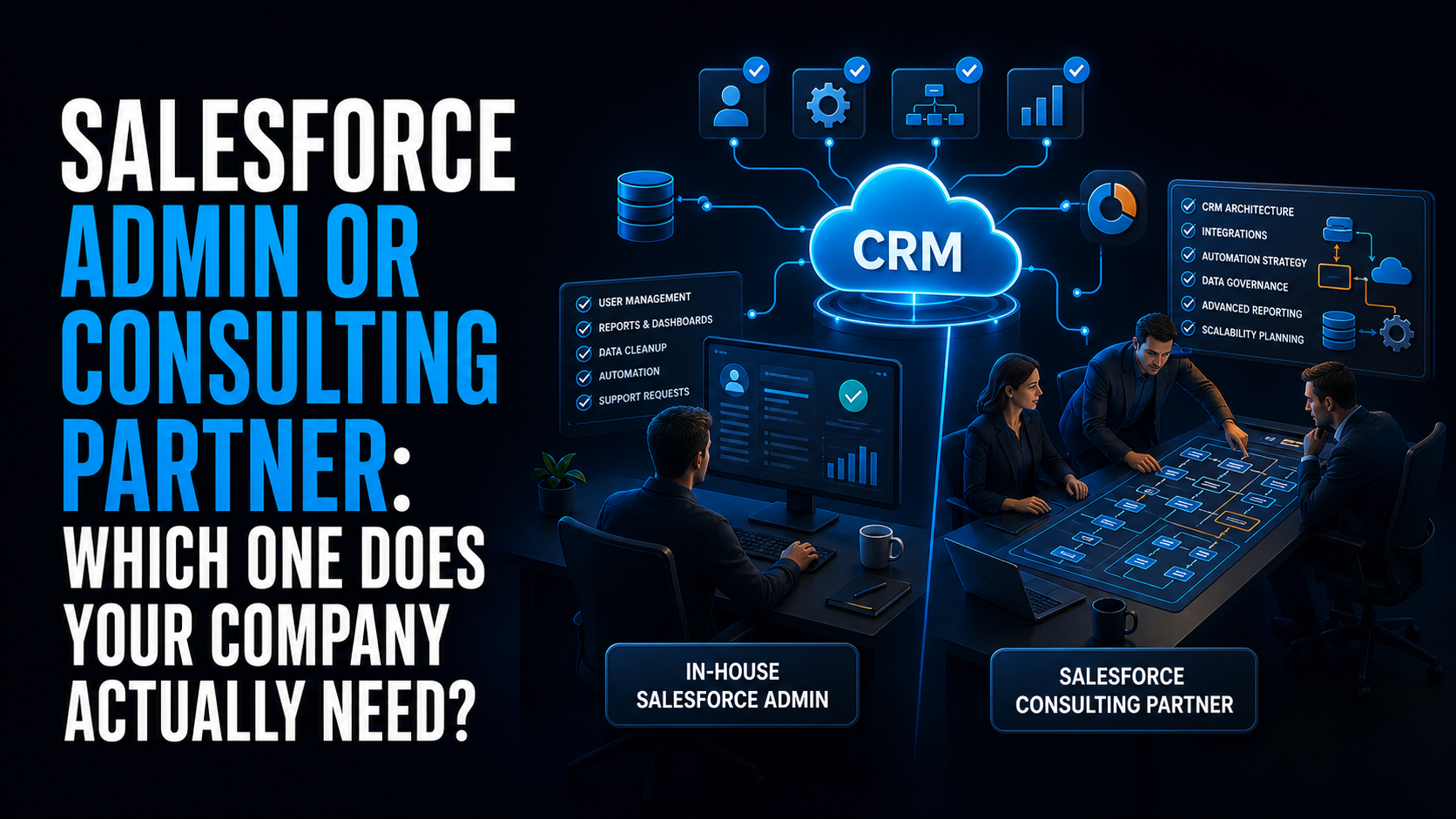
Those are different jobs. Treating them as interchangeable is how companies either overpay for routine administration or hand a transformation problem to one person who was hired to keep the platform running.
The right choice depends less on company size than on the type of work, the level of uncertainty, the skills required, and who must own the result.
What a Salesforce Admin Is Built to Own
A Salesforce administrator is usually closest to the business. That person learns how sales, marketing, customer success, finance, and leadership actually use the system. They see recurring support issues, understand which requests are urgent, and build institutional knowledge that an outside team cannot acquire overnight.
Salesforce describes administrators as professionals who manage users, data, security, analytics, and the platform itself. In practical terms, a strong in-house admin often owns work such as:
User setup, access, permission sets, and routine security administration
Reports, dashboards, list views, and recurring data requests
Fields, page layouts, record types, validation rules, and smaller automations
Release readiness and evaluation of useful platform features
User support, training, documentation, and adoption
Data-quality monitoring and routine cleanup
Backlog intake, prioritization, testing, and deployment for manageable changes
Coordination with vendors and internal stakeholders
An admin is not merely a ticket taker. A capable admin can improve processes, automate work, and advise the business. The deciding factor is whether the work fits within a platform and operating model that already make sense.
If your Salesforce org has clear ownership, stable integrations, trusted reporting, and a backlog made mostly of enhancements, an admin is probably the right foundation.
What a Salesforce Consulting Partner Is Built to Own
A consulting partner is useful when the problem crosses roles, systems, and decision boundaries. The value is not simply access to another person who knows Salesforce. It is access to discovery, architecture, delivery management, specialized skills, and an outside perspective that can challenge assumptions the internal team has learned to work around.
Salesforce's consultant-role guidance emphasizes discovery, business-case development, project management, implementation, training, and evaluation. That wider scope matters when a company is trying to change how work operates, not just configure a field.
A consulting partner is usually the better fit for:
A new implementation or major redesign
A failed implementation that needs diagnosis and recovery
Complex data migration, deduplication, or system consolidation
Multi-cloud architecture or specialized Salesforce products
Integrations involving marketing automation, billing, product, finance, support, or a data warehouse
Security redesign, permission-model changes, or compliance-sensitive work
Large automation refactoring involving Flow, Apex, packages, and external systems
Mergers, acquisitions, territory changes, or a new go-to-market model
Executive reporting and forecasting problems rooted in inconsistent business definitions
A roadmap that requires several skills at different points in delivery
The core question is whether you need ongoing platform ownership or a defined change in operating capability. A partner should be able to own the path from ambiguity to a tested result. If the engagement is only an expensive queue for small tickets, the model is wrong.
Use the Work Pattern to Make the Decision
Look at the work entering the Salesforce backlog for the last few months. Do not judge by ticket count alone. Classify the work.
Hire or strengthen an admin when the work is steady and repeatable
The case for an admin is strongest when requests arrive continuously, most changes are small to moderate, and the system's underlying design is not being questioned every week.
Examples include adding users, refining reports, adjusting layouts, improving a known process, maintaining documentation, supporting adoption, reviewing releases, and handling routine data-quality issues. These needs benefit from context, availability, and long-term ownership.
Use a partner when the work is concentrated and transformational
A partner makes more sense when the company has a major outcome to deliver within a defined period and the work requires discovery, architecture, migration, integration, testing, enablement, or several specialties.
The workload may be intense for four months and much lighter afterward. Hiring every required specialty permanently would be slow and expensive. A partner can bring those skills in the sequence the project needs them.
Use both when the platform matters enough to require continuity and depth
For many scaling companies, the best answer is not either-or. It is an internal admin who owns the platform and a partner who handles major initiatives, architecture reviews, specialized delivery, and temporary capacity.
The admin should be part of discovery, design, testing, documentation, and handoff. The partner should build the internal team's ability to operate the result. If the outside team creates a system only it can maintain, the engagement has created dependency instead of capability.
Signs You Need an Admin More Than a Partner
You probably need a dedicated admin when:
Users wait days for basic access or support
Nobody owns the backlog, documentation, release notes, or training
Small improvements pile up because every change requires a new external scope
Reporting requests are frequent but the definitions are already clear
Your integrations and architecture are stable
The business needs a consistent person who understands internal context
The volume of ongoing work is predictable enough to justify dedicated capacity
Do not use consulting rates to solve a permanent ownership gap. If the company will need the same category of work every week for the foreseeable future, create durable internal responsibility.
Signs You Need a Partner More Than Another Admin
You probably need a consulting partner when:
Nobody can agree on the root cause of the problem
The org contains years of conflicting automation and technical debt
A major implementation, migration, or integration has a fixed deadline
The work requires architecture, development, data, change management, and project leadership
Leadership does not trust pipeline, forecasting, or revenue reporting
Business teams use spreadsheets and side systems to bypass Salesforce
The current admin is capable but buried in operational work
A previous project produced configuration without clear ownership or adoption
These are not ordinary backlog problems. They require a structured assessment, decisions across teams, and a sequence that manages dependency and risk.
Before asking anyone to fix the org, use the Salesforce org audit checklist to clarify whether the main problem is process, data, security, automation, integrations, reporting, adoption, or governance.
Compare Total Ownership, Not Just Cost
An employee and a partner have different cost structures. An admin includes salary, benefits, recruiting, management, tools, training, and the risk of relying on one person. A partner includes fees, onboarding time, scope management, and the risk of losing context when the engagement ends.
Neither model is automatically cheaper.
Start with these questions:
Is the work ongoing or temporary?
Is the problem understood well enough to assign, or does it require discovery?
Can one person reasonably cover the required skills?
How quickly must the company produce a result?
Who will own the system after delivery?
Does the business have time and expertise to manage the work directly?
What documentation, testing, and knowledge transfer are required?
If cost is driving the decision, read the Salesforce consulting pricing guide. Hourly rate is only useful when the scope, responsibilities, and expected outcome are comparable.
Avoid the Two Most Expensive Hiring Mistakes
The first mistake is hiring an admin to rescue architecture while expecting that person to handle daily support at the same time. Even a strong admin will struggle if every focused design session is interrupted by access requests, broken reports, and urgent sales questions.
The second mistake is keeping a partner indefinitely for work that needs permanent internal ownership. The partner becomes the only source of context, every minor change requires coordination, and the company never develops a real platform owner.
Separate run work from change work. Run work keeps Salesforce dependable. Change work alters the operating model, architecture, or capability. Assign each category deliberately, even if the same team supports both.
A Practical Decision Rule
Choose an admin when you can clearly describe the recurring responsibilities and the org is stable enough for one owner to improve it over time.
Choose a consulting partner when the problem is ambiguous, the change is material, several specialties are required, or the consequences of getting the architecture wrong are high.
Choose both when Salesforce is important enough that you need internal continuity and external depth. Define decision rights, ownership, documentation, and handoff before work begins.
If you are still unsure, start with the CRM Hacker CRM Health Grader. Use the result to identify whether you have an operational ownership gap, a deeper architecture problem, or both. That is a better starting point than choosing a job title first.
About CRM Hacker
CRM Hacker helps scaling companies build Salesforce, RevOps, and AI-ready revenue systems that reduce operational chaos and improve visibility. Explore our Salesforce consulting services or Contact CRM Hacker to discuss the right ownership and delivery model for your team.