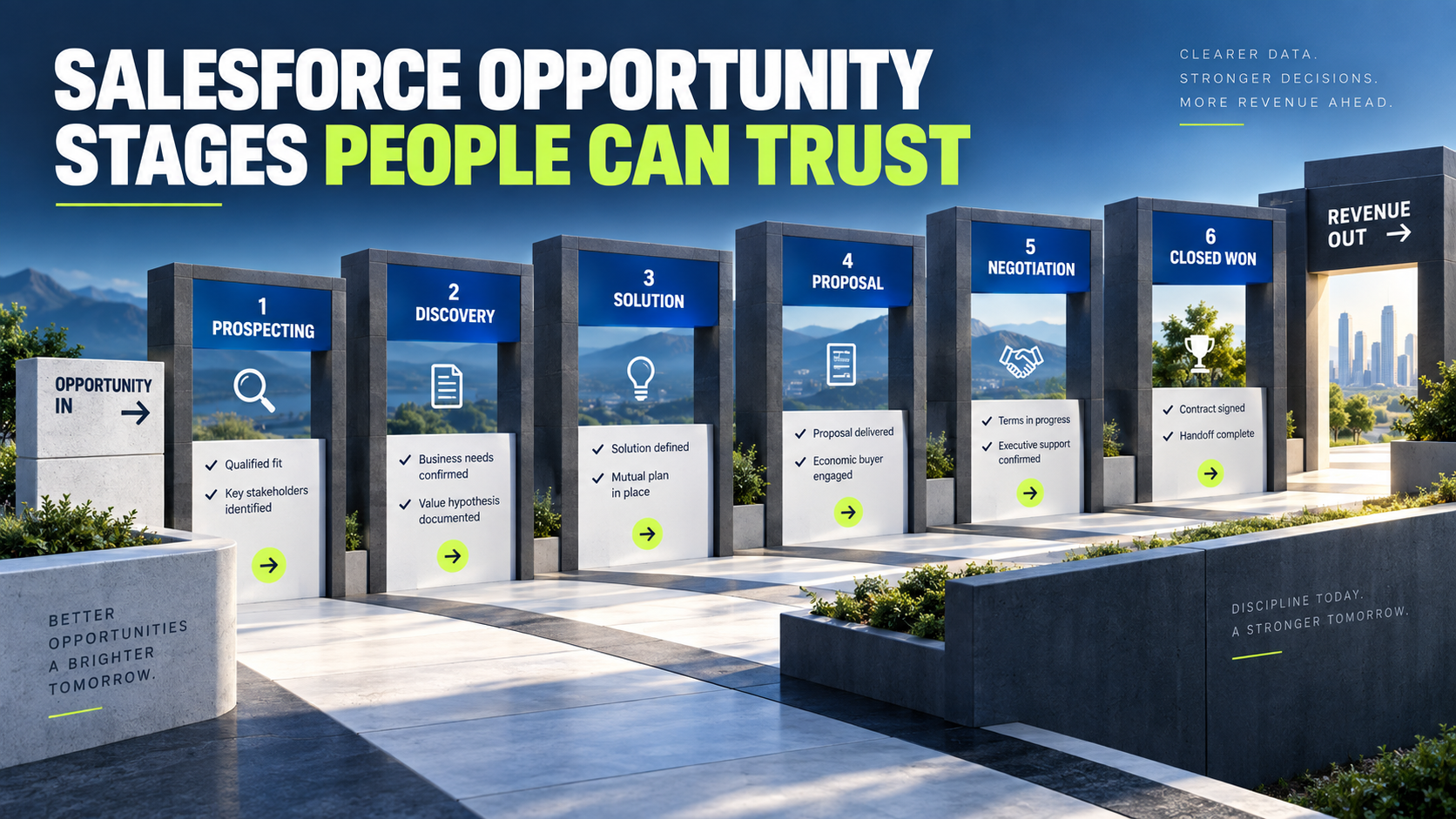
Salesforce opportunity stages are trustworthy when each stage represents an observable buyer commitment, has clear entry and exit criteria, and is used consistently by sales, operations, and leadership. Stage names alone don't create forecast discipline.
Most broken pipelines have too many stages, vague definitions, or stages based on seller activity. "Demo completed" tells you what the rep did. It doesn't tell you what the buyer agreed to do next.
Build Stages Around Buyer Progress
Define the buying decision your customer is making at each point. The exact labels vary by business, but advancement should always require evidence.
Give Every Stage Entry and Exit Criteria
What must be true before an opportunity enters
What buyer evidence is required to advance
Which fields must be complete
Who owns the next action
What disqualifies or moves the deal backward
The expected next step and date
Keep the criteria short enough to use during a live deal review.
Don't Turn Activities Into Stages
Calls, demos, proposals, and legal reviews may matter, but an activity isn't automatically progress. Track important activities separately. Use stages to represent the state of the buying decision.
Limit the Number of Stages
Every additional stage creates another definition to interpret, transition to govern, and opportunity for reporting inconsistency. If adjacent stages have the same probability, required fields, and management action, they may not need to be separate.
Align Probability With Evidence
Stage probability should reflect historical outcomes and current evidence, not a rep's desired result. Stage explains buyer progress. Forecast category communicates judgment about whether and when the deal will close.
Make Required Fields Earn Their Place
Who uses this field?
What decision does it support?
When can the seller reasonably know it?
Can it be derived?
What happens when it changes?
The Salesforce org audit checklist can uncover fields, validation rules, and automations that no longer support the current process.
Define Closed-Lost and Recycling Rules
Require a useful loss reason and distinguish no decision, bad fit, timing, budget, and competitive loss. Define how a future deal enters nurture without inflating active pipeline.
Test the Model Against Real Deals
Walk a representative sample of active and historical opportunities through the definitions. If experienced sellers can't consistently place the same deal in the same stage, the criteria are ambiguous.
Govern Changes After Launch
Stage changes affect automation, reporting, integrations, forecasting, enablement, compensation, and historical analysis. Use a CRM governance framework to define ownership, approvals, and testing.
The Standard Is Management Usefulness
A stage model succeeds when a manager can see what happened, what evidence exists, what must happen next, and where help is needed. If the pipeline can't support that conversation, adding colors to a dashboard won't make it trustworthy.
Use the CRM Health Grader to identify broader risks across process, data, reporting, automation, and adoption.
About CRM Hacker
CRM Hacker helps scaling companies build Salesforce, RevOps, and AI-ready revenue systems that reduce operational chaos and improve visibility. Explore our Salesforce consulting services or Contact CRM Hacker to design opportunity stages your teams can actually use.